The story of Véronique and Frédéric, graduates and owners of Maison 1643
Institut LyfeExecutive Education
With plans to open a bed and breakfast, Véronique and Frédéric first trained at Institut Lyfe Executive Education through the ‘Cuisine & Horizon’ career change programme. Once their establishment, Maison 1643, had opened in the Gard, they wanted to take things further by enhancing their skills through the advanced training course on Pâtés en croûte, pies and creative charcuterie, so that they could offer their customers homemade charcuterie creations
Tell us a bit about yourself: what were you doing before you started the Cuisine & Horizon course?
Before taking the Cuisine & Horizon programm, I [Véronique] worked in retail. I started out as a bookseller, then worked as an advisor in a kitchenware shop, before becoming manager of a delicatessen. My husband, Frédéric, had been a freelance graphic designer for 25 years.
What were your career plans before taking the Cuisine & Horizon programm?
My husband and I had plans to open a guesthouse, Maison 1643. As we are both passionate about cooking, we also wanted to offer a table d’hôte service as a complement to this. We therefore needed to develop our professional skills, learn the techniques required for professional cooking, and obtain the necessary certificates to open an establishment like this.
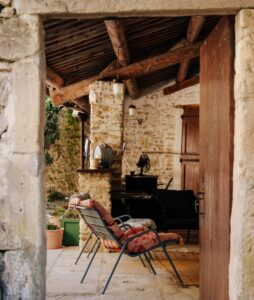 My husband and I had plans to open a guesthouse, Maison 1643. As we are both passionate about cooking, we also wanted to offer a table d’hôte service as a complement to this. We therefore needed to develop our professional skills, learn the techniques required for professional cooking, and obtain the necessary certificates to open an establishment like this.
In what way was this career retraining crucial to the opening of Maison 1643?
This career retraining reinforced our desire to become professional chefs, with all the demands that entails. Even if you love cooking, it’s not the same doing it for yourself as it is for customers, even if there are only a few of them.
It also gave us a better understanding of the financial management of a business: controlling costs, setting realistic margins and ensuring the long-term viability of our business.
How have your respective roles developed since Maison 1643 opened four years ago?
We do everything ourselves, which means that during the peak season (from April to the end of October), our days are very intense, with no days off.
In the kitchen, we work as a team. I’m the more creative one of the pair: I take care of the amuse-bouches, starters and desserts. Frédéric, on the other hand, has a more technical role: he manages the main courses, cooking, meat and fish, side dishes, as well as certain preparations such as pâtés en croûte. He also selects the wines from neighbouring estates that we serve to our guests.
Together, we put together the menu, select the produce, and oversee the preparation and service, from breakfast to dinner.
As for the guest rooms, we manage guest reception, room preparation and check-outs. Maintenance is also a significant part of our daily routine, whether for the house, which dates back to the 17th century, or for the outdoor areas, including the garden and the swimming pool.
Added to this are bookkeeping and marketing, which are essential for promoting our establishment. The season is intense, but winter allows us to rest and recharge our batteries before we start again.
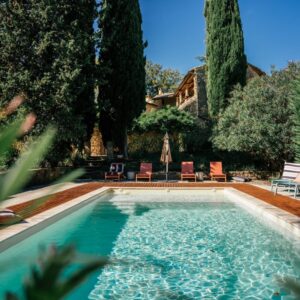 We do everything ourselves, which means that during the peak season (from April to the end of October), our days are very intense, with no days off.
Why did you decide to take an advanced training course?
As residents of Lyon, we were keen to offer regional specialities at our restaurant. Pâtés en croûte, in particular, can be adapted to the seasons using different ingredients. However, we lacked the technical expertise to produce them to a high standard. So we took a three-day course on pâtés en croûte, pies and creative charcuterie.
How did the advanced training go?
The course on pâtés en croûte, pies and creative charcuterie was very intensive, but extremely rewarding. Over the course of three days, we acquired a real level of expertise that we are already putting into practice.
What makes the difference is the precision of the techniques taught. They now enable us to work more efficiently, save time on preparation and have greater control over our creations.
The training course met our expectations perfectly: it was challenging, highly educational, and provided ample quantities of high-quality ingredients.
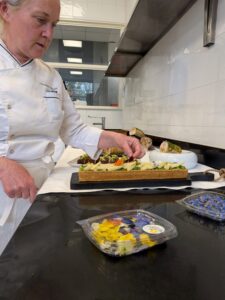 The course on
 What advice would you give to someone thinking of changing careers to work in the culinary profession?
It is essential to undertake comprehensive training that leads to the necessary qualifications and certificates. You can’t just wing it as a chef, and surrounding yourself with professionals to learn from is absolutely essential. Then, if you want to set up your own business, you also need to be prepared to work hard and make sacrifices, know how to surround yourself with the right people, and not embark on a project alone without support.
Véronique and Frédéric’s journey shows that a career retraining is possible, provided you give yourself the means to achieve your ambitions. By drawing on tailored and rigorous training programmes such as those offered by Institut Lyfe Executive Education, they have successfully turned a shared passion into a concrete life project.